요오드를 전자수용체로 한 항히스타민제의 분광학적 분석
Spectrophotometric Determination of Antihistaminics by using Iodine as Electron Acceptor
- 대한약학회
- 약학회지
- 제33권 제3호 (1989년)
-
1989.06141 - 148 (8 pages)
- 5
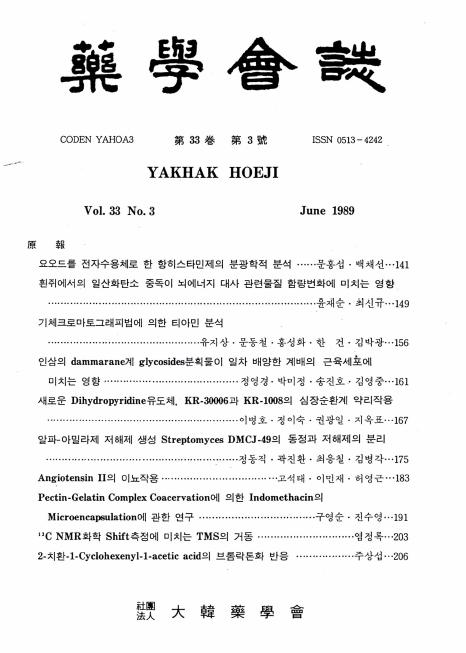
The weak UV absorbing antihistaminics such as chlorpheniramine, triprolidine, tripelennamine and diphenhydramine were analyzed by charge-transfer spectrophotometric method. The results obtained are summarized as follows. It was possible to determine a weak UV absorbing antihistaminics using the intense charge-transfer UV bands in chloroform. Charge transfer complexes were formed in a 1:1 ratio between antihistaminics and iodine in chloroform. Linear relationship was found between absorbance and concentration in the range of 1.0 X 10⁻⁵M-5.O X 10-5M for chlorpheniramine(epsilon=2.082 X 1O4)and tripelennamine(epsilon=1.578 X 1O4), 1.O X 10-5M-8.0 X 10⁻⁵M for triprolidine(epsilon=1.120 X 1O4) and 1.0 X 10⁻⁵-1.0 X 10⁻⁴M for diphenhydramine(epsilon=9.900 X 10³). Charge transfer complexes of chlorpheniramine, triprolidine and tripelennamine have absorption maxima at 293nm and complex form of diphenhydramine has absorption maximum at 270nm. By UV, IR spectra, it could be inferred that CT-complexes were formed by interaction between the basic nitrogen of antihistaminics as electron donor(non bonding electron) and iodine as electron acceptor(sigma bonding electron).
(0)
(0)