[특별기고] 21세기 복합위기 극복을 위한 4차 산업혁명시대의 전망과 과제
The Challenges in the Era of the Fourth Industrial Revolution toward the Multiple Crisis
- 4차산업혁명융합법학회
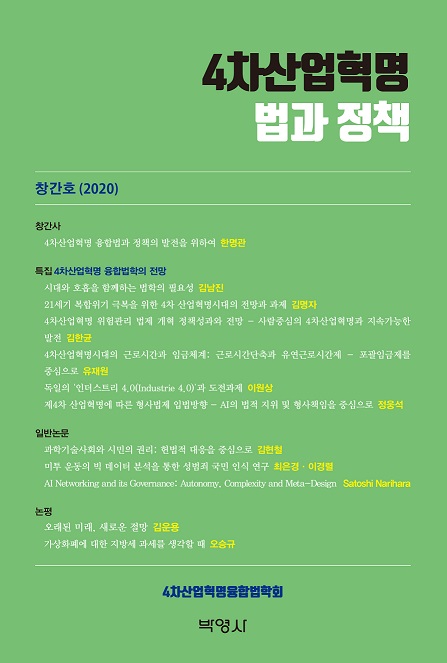
- 4차산업혁명 법과 정책
- 창간호
-
2020.0733 - 64 (32 pages)
- 1,650
The 21st Century’s hyper-connected world is experiencing unprecedented challenges from the COVID-19 pandemic abruptly placing much of the world’s population under massive lockdown. As we begin to witness gradual lifting of lockdown restrictions, speculation is rife as to what the future holds for the post-COVID world, leading to the prevailing view that the ‘new normal’ will be marked by the prevailing nationalism and protectionism as the pandemic spells the end of hyper-globalization. Seen in the Science, Technology and Innovation (STI) perspective, the novel coronavirus will fast-track the Fourth Industrial Revolution and the resultant exponential transformation. The pandemic and its ensuing risks are multi-dimensional, driving them inextricably intertwined and interdependent. As such, shaping an integrated and holistic response, buttressed by international cooperation, is indispensible in addressing these risks. It is a truism that a global partnership is key to jumpstart the development and distribution of the treatments and vaccines against COVID-19. Grounded on a projection that the disruption of global value chains in the wake of deglobalization will shore up the regional networks and the state-centric production ecosystem, this article underscores the need for the government’s bold fiscal policy and a transition to a negative regulatory framework that could usher in the new chapter of innovation for the Fourth Industrial Revolution represented by promising investment areas such as smart healthcare, AI, Big Data, Cloud, 5G, FinTech, smart factories, and AR/VR. In establishing new order suitable for the ‘untact era’, an innovative industry and business ecosystem should thrive in no case from laws or regulations, but from new norms that will set the standard for respective fields including economy, industry, education, health, safety, and so forth. Above all, the article recapitulates that international community can fully reap the benefit of common prosperity and sustainable development, only when the Fourth Industrial Revolution can adequately contribute to unraveling abject socio-economic-environmental challenges facing the world today, such as climate crisis, resource constraints, environmental pollution, devastated ecosystem, health security and wealth disparity.
1. 서론: 코로나바이러스 사태로 AC와 BC로 나뉜 세상
2. 포스트 코로나 시대 뉴 노멀 2.0
3. 역사 속의 산업혁명의 성격
4. 역사 속의 산업혁명과 주요 사건
5. 코로나 이후의 수정 자본주의는?
6. 코로나 이후 뉴 노멀 2.0 구축: 4차 산업혁명이 기여해야 한다.
7. 뉴노멀 구축의 알파이자 오메가는 규제 혁신이다.
8. 맺음말: 지속가능발전으로의 패러다임 전환
참고문헌
(0)
(0)