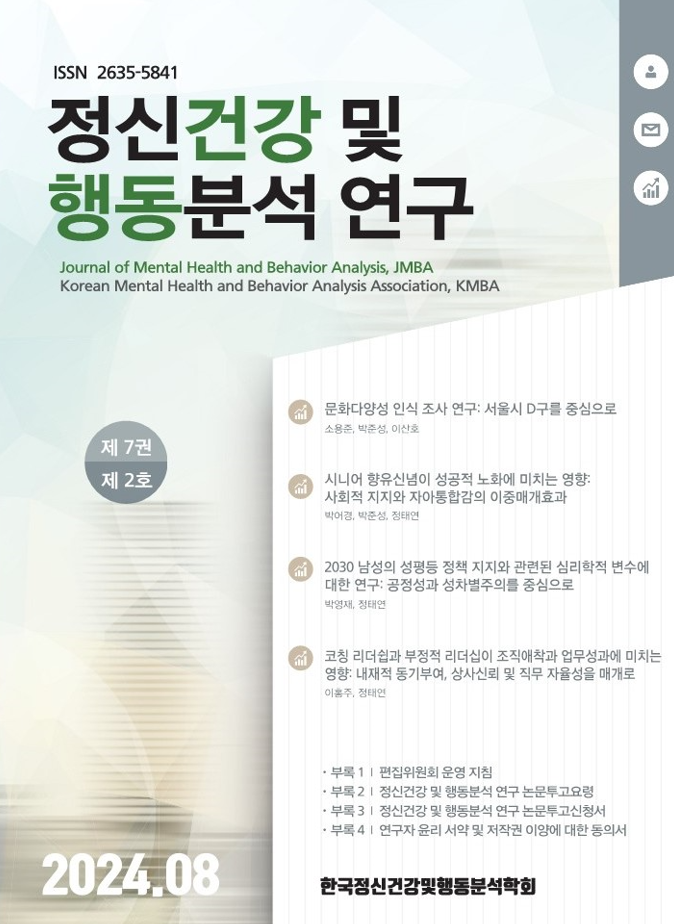
코칭 리더십과 부정적 리더십이 조직애착과 업무성과에 미치는 영향: 내재적 동기부여, 상사신뢰 및 직무 자율성을 매개로
The Impact of Coaching Leadership and Negative Leadership on Organizational Attachment and Job Performance: Through mediating effects of intrinsic motivation, trust in supervisor and job autonomy
- 한국정신건강및행동분석학회
- 정신건강및행동분석연구
- 제7권 제2호
-
2024.0883 - 111 (29 pages)
- 202
본 연구는 수도권 소재 기업체 근로자 중 CEO를 제외한 종사자 250명을 대상으로 직장상사의 코칭 리더십과 부정적 리더십이 내재적 동기부여, 상사신뢰 및 직무 자율성을 매개하여 조직애착과 업무성과에 영향을 미치는 관계를 확인하였다. 연구 결과 직장상사의 코칭 리더십은 조직애착과 업무성과에 영향력 있는 주요변인이며, 직장상사의 코칭 리더십이 조직애착과 업무성과에 미치는 영향을 내재적 동기부여, 직무 자율성과 상사신뢰가 매개변인으로 유의미하다는 것을 확인하였다. 따라서 코칭 리더십은 구성원들에게 스스로 문제를 해결 할 수 있도록 도와주고, 잠재력을 끌어올릴 수 있도록 이끌어 주며, 인정과 격려를 통한 진정한 관계는 구성원들의 조직애착과 업무성과의 수준을 향상시킬 수 있는 동력이 될 수 있음을 알 수 있었다. 또한 이러한 결과를 토대로 조직에서의 코칭 리더십은 구성원들이 자신의 직무에 좀 더 만족감을 느끼며, 조직에 대한 관심과 애착을 갖고 임할 수 있도록 영향력을 발휘할 수 있는 강력한 리더십이 될 수 있을 것임을 알 수 있었다.
This study examined the relationship between workplace supervisors' coaching leadership and negative leadership on organizational commitment and job performance, mediated by intrinsic motivation, supervisor trust, and job autonomy, among 250 employees (excluding CEOs) of companies located in the metropolitan area. The results showed that supervisors' coaching leadership is a significant variable influencing organizational commitment and job performance. It was confirmed that intrinsic motivation, job autonomy, and supervisor trust significantly mediate the impact of coaching leadership on organizational commitment and job performance. Therefore, coaching leadership can help members solve problems on their own, guide them to unlock their potential, and establish genuine relationships through recognition and encouragement, serving as a driving force to enhance the level of organizational commitment and job performance. Based on these results, it was found that coaching leadership within organizations can be a powerful leadership style that enables members to feel more satisfied with their jobs and approach their roles with interest and commitment.
Ⅰ. 서 론
II. 연구방법
Ⅲ. 결 과
IV. 논 의
참고문헌
(0)
(0)